



Showing posts with label Analysis. Show all posts
Showing posts with label Analysis. Show all posts
Friday, May 30, 2008

Friday, May 9, 2008
BACKGROUNDER: Dictators' priority
By Christiane Oelrich, dpa
While bloated corpses still litter Irrawaddy delta fields, the controlled media promote the referendum. While a million Burmese in deep shock fight for their survival, government ministers give speeches on the "flourishing discipline democracy."
Mae Sot - The ruling military junta of Burma has imposed a vacation ban for all officials - but not so every last person can be available to assist survivors of the recent cyclone that devastated the country.
Instead, the officials have to remain available to organise Saturday's referendum on the new constitution, with which the generals intend to cement their power.
"This clearly shows their priorities," said Bo Kyi who, as a political prisoner, spent more than seven years in a military-run torture camp before he fled across the border into Thailand.
"They won't allow their ploy to be spoiled even by tens of thousands of dead," he added.
According to the government, nearly 23,000 people were killed and as many as 42,000 are missing since Cyclone Nargis smashed into central Burma on May 2 and 3.
While bloated corpses still litter fields across the Irrawaddy river delta, the regime-controlled media continue to busily promote the referendum.
And while a million people in deep shock fight for their survival, government newspapers inform about upcoming election speeches by different ministers under the concept of a "flourishing discipline democracy."
If adopted, the new constitution will secure the military a staggering 25 per cent of parliamentary seats as well as key ministerial positions in the government.
Some opponents already have made acquaintance with the proclaimed "flourishing discipline."
Inhabitants of Rangoon (Rangoon), the country's main port city and former capital, who dared to publicly wear "Vote No!" T-shirts prior to the cyclone were arrested.
Members of the oppositional National League for Democracy (NLD) were beaten in the streets.
"The junta wants to merely legitimise their regime with the constitution. They want a licence to kill," asserted Bo Kyi, who founded a non-governmental organisation, the Association for the Assistance of Political Prisoners (AAPP), to help incarcerated dissidents and their families.
He is convinced that the country's voters will reject the constitution, especially at a time when the regime has forsaken the people in their hour of greatest need.
On Thursday, hundreds of thousands were still awaiting help while international emergency relief volunteers were stuck in neighbouring countries because they couldn't obtain entry visas.
"We have received nothing so far," said Soe Win, a resident of Kawhmu township some 35 kilometres south of Rangoon.
His sister and 7-year-old nephew were killed by a falling tree that was uprooted by the cyclone.
"Everybody here is deeply upset and we all certainly will vote 'no'," he said.
Meanwhile, those familiar with the regime's workings don't harbour any illusions about the referendum result that the ruling generals =
are likely to announce.
"The junta just cannot be trusted. They will never give up their sabotage [of democracy]," said NLD member Win Hlaing, 45, who in 1990 won a parliamentary seat during the country's last national election, which saw a landslide victory for the NLD.
The junta ignored the outcome and put opposition leader Aung San Suu Kyi under house arrest, where she remains till this day.
Win Hlaing himself also spent 10 years in prison before last year fleeing to Mae Sot, a little town on the Thailand side of the border.
Since then, the junta has trained the country to give frightened obedience.
Similar to the Stasi agents of former East Germany, the regime's henchmen have infiltrated everywhere and nothing goes unnoticed by them.
Associations, companies and even individual families are required to regularly delegate participants to official parades which tens of thousands of spectators are expected to cheer.
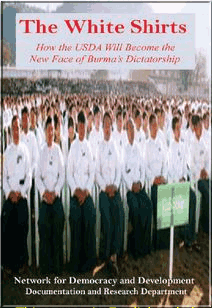
It is anticipated that regime supporters of the United Solidarity and Development Association (USDA) will be deployed during the referendum to "assist" voters in their decision-making.
ULDA allegedly has 24 million active members, about half of the country's total population.
The regime reared its ugly head most recently in September last year when it ordered troops to open fire on tens of thousands of peaceful protesters and monks in Rangoon.
Official figures put the death toll at 31 people, but human rights activists believe that dozens more lost their lives.
The opposition is convinced that a new public uprising is only around the corner.
"Our next phase of struggle will begin after the referendum," said Win Hlaing. He claimed that the NLD maintains secret observers throughout the country to expose election fraud.
"The people are angry with the military. They only need one little spark to explode again," he added.
If that happens, said Bo Kyi, it would have to be the hour of the international community to get involved.
"The United Nations will have to support the will of (Burmese) people, not the will of the junta," he explained.
He rejected the idea of avoiding a confrontation in order to not jeopardise a dialogue with the paranoid generals.
"You may play the violin to a buffalo, but it won't listen," he said, citing a local proverb.
(Source-http://www.bangkokpost.com/topstories/topstories.php?id=127566)
Thursday, May 8, 2008
Left in the lurch
Bangkok Post and Agencies
Day Six of the cyclone disaster: The junta still has not even responded to a request that it waive visa requirements for relief agencies. The senior US diplomat in Burma and the exile government in Thailand said separately the death toll is likely 100,000, and the first hungry crowds of survivors stormed village shops, desperate for food.
International relief agencies are still waiting for permission to enter Burma so they can take much-needed aid to hundreds of thousands of victims of Cyclone Nargis.
The weekend cyclone left millions homeless and without food and water.
The government says more than 22,000 people have been killed and more than 40,000 people are missing.
More than 100,000 people need urgent humanitarian assistance.
American diplomat Shari Villarosa, who heads the US embassy in Rangoon, said the number of dead could eventually exceed 100,000 because safe food and water were scarce and unsanitary conditions widespread.
The situation is "increasingly horrendous," she said in a telephone call to reporters. "There is a very real risk of disease outbreaks."
Aung So, director of the office of the country's exile government in Mae Sot in northern Thailand, also said "we are assuming that at least 100,000 have died."
A few shops reopened in the Irrawaddy delta, but they were quickly overwhelmed by desperate people, said Paul Risley, a spokesman for the U.N. World Food Program in Bangkok, Thailand, quoting his agency's workers in the area.
"Fistfights are breaking out," he said.
A foreign resident of Rangoon who returned to the city from the delta area said people were drinking coconut water because there was no safe drinking water. He said many people were on boats using blankets as sails. Of course he could not allow use of his name, because the military dictators threaten to punish any one who talks.
The UN asked the government in Burma to waive visas for relief workers assembled in Bangkok so they can begin their journey to Burma, said Rachid Khalikov, an official of the UN emergency relief department.
"So far, there are no instructions for visas in Bangkok," Mr Khalikov said.
International charity Save the Children said Burma authorities had given aid workers no word on when visas would be granted.
"We have no idea of what progress, if any, will be made on visa management," its Bangkok-based spokesman Dan Collinson said after meeting relief agencies at UN offices here.
"We're frustrated. At the moment we still have a reasonable amount of capacity in-country, but that's going to run out quickly," he said.
"I think the maximum amount of pressure is being applied at the highest level of UN discussions."
Burma's junta is also barring foreign journalists from entering the country and has expelled one BBC reporter, state media said. BBC Asia correspondent Andrew Harding was stopped by Burmese immigration officials at Rangoon International Airport from entering the country on Monday, and sent back to Thailand, state-run MRTV reported.
Richard Horsey of the UN disaster response office said Burma's junta knows it needs outside help, but it must act now to remove red tape delaying a massive international aid operation.
With large swathes of the Irrawaddy delta under water and so many people in need of help, the disaster presents a "major logistical challenge", said Mr Horsey. "The government recognises this is an unprecedented emergency for Burma and it will require a huge relief effort with a big international component," he said.
"Visa applications have been in for 24 to 48 hours," Mr Horsey said. "Now is the time that movement is expected on that and we do look to the authorities to issue the necessary clearances."
In Thailand, Woradet Veerawekin, deputy director-general of the Department of Information in the Ministry of Foreign Affairs, said Her Royal Highness Princess Maha Chakri Sirindhorn ordered her personal secretary Khunying Araya Piboonnakarin to check what basic necessities were in demand, so that relief could be granted.
Meanwhile, Burmese officials have denied they will close the border checkpoint of Tachilek during the country's charter referendum, which will take place in some areas tomorrow and on Saturday. They said the route was important for transporting food and medicines to victims of the cyclone.
The junta decided to postpone the referendum from Saturday to May 24 in five cities, including the former capital of Rangoon, which was hit by the storm.
Meanwhile, permanent secretary for the Public Health Ministry Prat Boonyawongwiroj said people wanting to donate drinking water or food to help the Burmese could take items to the ministry, the Food and Drug Administration, the air force or the Thai Red Cross.
(Source-http://www.bangkokpost.com/topstories/topstories.php?id=127541)
ANALYSIS: Burma storm clouds
By Peter Janssen, dpa
There is one thing Burmese military rulers can expect in the wake of Cyclone Nargis, which killed more than 22,500 people and wrecked the country's rice bowl: Anger, and a lot of it.
Burmese have been suffering under military rule for the past 46 years, watching their once prosperous country fall from its perch in the 1950s as Asia's leading exporter of rice and other commodities to its current status, in United Nations jargon, as "least developed developing nation."
During the decades of the military's economic mismanagement and brutal political suppression, the one thing the generals had in their favour was a mild climate, which along with fertile land provided an assurance that no matter how bad their rule, the people would have enough to eat.
Now that certainty has been shattered by Mother Nature.
Cyclone Nargis, packing 200-kilometre-per-hour winds, hit the central coastal region last Friday, inundating the Irrawaddy Delta with tidal waves and floodwaters and smashing much of the fragile infrastructure of Rangoon, the country's largest city and commercial hub.
The extent of the damage wrought on the Irrawaddy Delta remains unknown, with access still a problem days after the storm.
What is clear is that the cyclone hit after the main paddy crop had been planted, and Burma faces a serious short-term and possible long-term problem in feeding its people.
"This disaster is going to last," said one European diplomat. "It's not something that is going to be over in a couple of weeks or months. It will have far-reaching consequences until the next harvest."
The rich alluvial plains of the Irrawaddy account for at least 60 per cent of the rice crop, the country's staple food.
Nobody yet knows how much rice the government had stockpiled, but it can be assumed that many warehouses were damaged by the storm. This looming food crisis, both for the cyclone's victims (the number of people in need of assistance is estimated at 24 million) and for the country as a whole, has forced the junta into a situation of unprecedented dependence on the international community to bail it out.
To the surprise of some, the ruling junta, which has prided itself in the past on its indifference to international opinion, has had to appeal for disaster relief in order to save its own people and, ironically, to save itself.
"If they don't get enough proper assistance out in the next couple of days or weeks the people will be very angry, and that anger might overcome their fear because they may feel they have nothing to lose," said Win Min, a lecturer on Burmese affairs at Chiang Mai University.
While acknowledging that they need emergency aid from the international community, the military dictatorship appears to be trying its best to claim the credit for the largesse by controlling its distribution to the devastated countryside.
"They are delaying visas for foreign aid workers, which is a clear sign that they want the materials but don't want the foreign workers," said Win Min.
So far, the government has refused to waive visas requirements for teams trying to bring in foreign aid, although this may change as the magnitude of the catastrophe sinks in.
Meanwhile, Western donors are trying to make sure the emergency relief is delivered and a major disaster averted, while at the same time trying to assure that it is not squandered.
"We are ready to provide help without political bargaining but at the same time we have to have a minimal number of people in the country to know what is going on to assess the scene and make sure it is well spent," said a Western diplomat. "At the end of the day it is an issue of access."
Any delays in the delivery of goods is likely to lead to a lot more anger among the people, and that anger may be expressed at the upcoming referendum scheduled for Saturday, a military-managed affair that is intended to endorse a new constitution that will essentially cement their dominant role in all future governments.
Despite the cyclone, the junta plans to go ahead with the May 10 referendum, although it has postponed the vote in 47 of the worst-hit townships until May 24.
"For the time being people are concerned with survival, burials, etc, but even people in areas not affected are angry at the governments lack of warning and slow response, so more will vote "no" on Saturday," predicted Bo Kyi, spokesman for the Assistance Association for Political Prisoners (AAPP), a group based on the Thai-Burmese border.
It is assumed that the military will make sure that the referendum will result in a positive endorsement for the constitution, but any obvious rigging of the vote will likely make the people even more angry, said Bo Kyi.
(Source-http://www.bangkokpost.com/topstories/topstories.php?id=1275380
Monday, May 5, 2008
Analysis: Little chance for May 10 Burma referendum
By dpa correspondents
Bangkok/Rangoon (dpa) - Cyclone Nargis, which pounded central Burma over the weekend leaving at least 351 people dead and the country's largest city paralysed, may force the ruling junta to rethink their plans to hold a referendum next Saturday.
But state media Monday indicated the military junta intends to go ahead with a referendum Saturday on a new constitution that promises to cement the military's dominant role in the country's politics.
"The referendum is only a few days away, and the people are eagerly looking forward to voting," according to a government statement carried by the regime's propaganda mouthpieces.
The referendum on May 10 is to decide the fate of the new constitution, a document that promises to cement the military's dominant role in the country's politics following the next general election scheduled some time in 2010.
In any other country, the postponement of a national vote would be inevitable after such a devastating natural disaster, but Burma, has not obeyed international norms for decades.
The cyclone, which slammed into the central Burmese coastal states Friday night packing 200 kilometres per hour winds, has left Rangoon's fragile infrastructure in shambles and claimed hundreds of lives in the Irrawaddy Division, Burma's rice bowl.
Up to 100,000 may have been left homeless by the storm, many more are roofless and Rangoon, a city of several million inhabitants, is likely to be without electricity for weeks.
"It's a catastrophe," said one western diplomat. "Almost all the electricity poles were blown down. It will take weeks to repair. I don't see how you can conduct a referendum under those conditions."
Given Burma's limited budget and poor past performance in disaster management, there is a high likelihood that millions of people will have more pressing matters on their minds than the referendum come Saturday.
But that may not stop Senior General Than Shwe, the military supremo who heads the State Peace and Development Council (SPDC) - as the ruling junta has styled itself - from pushing the referendum through.
It was Than Shwe who set the referendum date for May 10, and only Than Shwe can decide to postpone it.
"Than Shwe is very stubborn, and it's very important for him to hold the referendum by this date. He will not postpone it unless he sees no other option," predicted Win Min, a lecturer on Burmese affairs at Chiang Mai University, in neighbouring Thailand.
Than Shwe chose the May 10 date because it was "an auspicious date" and because it has allowed little time for opponents to organise campaigns against the referendum, said Win Min.
Now Than Shwe will need to decide whether the stars have spoken against his divine plan.
"Many people are saying this (cyclone) is a bad omen for the regime, and punishment for their crackdown on Buddhist monks last September," said Win Min.
On September 26 to 27, the junta unleashed its troops on hundreds of Buddhist monks who had led anti-government protests in Rangoon, sending thugs to beat and round up the protectors of Burma's national religion.
The brutal onslaught, that left at least 31 dead, enraged the country's predominantly Buddhist population against their rulers and drew harsh criticism from the international community.
It was partly in response to that growing pressure that Than Shwe in February announced plans to hold a referendum that will decide on the country's new constitution and ultimately pave the way for a general election in 2010.
The constitution, however, holds little promise for true democracy in Burma, a country that has been ruled by the military since 1962.
The referendum itself has been condemned by human rights groups for being neither free nor fair, but rather being held amid widespread repression, media censorship, bans on political gatherings, the lack of an independent referendum commission and courts to supervise the vote, and a pervasive climate of fear.
The military has made it clear that they want the constitution to be approved, and since they control the referendum process and vote-counting, its approval seems inevitable.
The new charter assures the military a dominant role in the future Burma by granting the military the right to appoint 110 members of the 440-seat lower house and 56 members of the 224-seat upper house.
Control of this 25 per cent of both houses would effectively bar amendments to the charter that might threaten the military's dominance, since for an amendment to pass, it would require more than 75-per-cent support.
Whether or not the military will risk pushing their constitution through on Saturday, despite the harsh warning from cyclone Nargis, remains to be seen.
"Whatever happens, one thing that has made the military very happy is that the cyclone has blown away all the satellite dishes on peoples' homes in Rangoon, so now they will not be able to watch cable-TV news anymore," joked Win Min.
(Source-http://www.bangkokpost.com/breaking_news/breakingnews.php?id=127485)
Subscribe to:
Posts (Atom)